
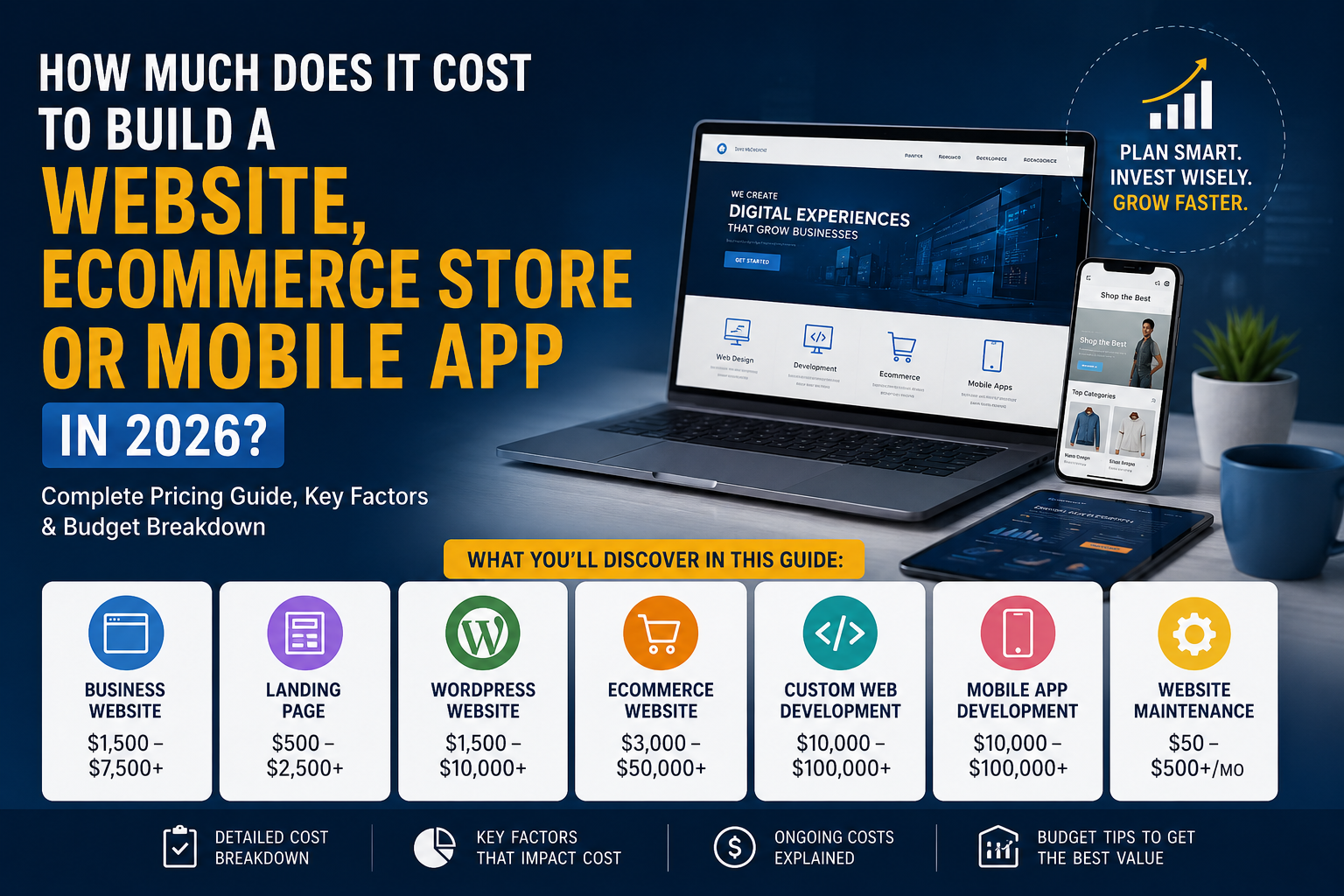
How Much Does It Cost to Build a Website, Ecommerce Store or Mobile App in 2026?
If you're planning a new website for your business, one of the first questions you're likely to ask is:
“How much will it cost?”
Unfortunately, there isn't a single price that applies to every project.
A five-page website for a local business is very different from an ecommerce store processing hundreds of orders, and both are considerably different from a custom web application or mobile app.
A realistic development budget depends on what you're building, how much customization you need, the technology involved, integrations, content requirements, and what the website or application needs to accomplish for your business.
In this guide, we'll break down the major costs involved in building:
Business websites
Landing pages
WordPress websites
Ecommerce stores
Custom websites and web applications
Mobile applications
Website redesigns
SEO-friendly websites
Ongoing website maintenance
We'll also explain what actually influences development costs so you can create a realistic budget before approaching a web development company.
Quick Website Development Cost Overview
Here are broad 2026 planning ranges in USD. Actual quotes can fall below or above these figures depending on scope.
Simple landing page: $500 – $2,500+
Small business website: $1,500 – $7,500+
Custom business website: $3,000 – $15,000+
WordPress website: $1,500 – $10,000+
Small ecommerce website: $3,000 – $12,000+
Advanced ecommerce platform: $10,000 – $50,000+
Custom web application: $10,000 – $100,000+
Mobile application: $10,000 – $100,000+
These are budgeting ranges rather than fixed prices.
The same type of website can vary significantly in cost depending on design complexity, number of pages, functionality, integrations and who builds it.
Let's look at each category in more detail.
1. How Much Does a Business Website Cost?
A professional business website is one of the most common web development projects.
For many small and medium-sized businesses, a website might include:
Homepage
About page
Services pages
Contact page
Enquiry forms
Testimonials
Portfolio or case studies
Blog
Mobile-responsive design
Basic search engine optimization
Analytics integration
A relatively straightforward business website might cost around $1,500–$7,500+, while a highly customized corporate website can cost considerably more.
The biggest difference is usually whether you're purchasing a lightly customized template or commissioning a website designed and developed specifically around your business.
Businesses looking for a professionally developed site can explore our Website Design & Development Services.
2. How Much Does a Landing Page Cost?
Landing pages may contain only one page, but that doesn't necessarily make them simple.
A conversion-focused landing page may require:
Custom UI/UX design
Strong headline and content hierarchy
Lead-generation forms
WhatsApp or phone CTAs
CRM integrations
Analytics
Meta Pixel
Google Ads tracking
Conversion tracking
Speed optimization
Mobile optimization
A/B testing capabilities
A professionally designed landing page could therefore range from approximately $500 to $2,500+.
The cost increases when custom integrations, animations, calculators, booking systems or advanced tracking are required.
For businesses running paid advertising, investing in a strong landing page can be particularly important because even a small improvement in conversion rate can affect the return generated from the entire advertising budget.
3. How Much Does a WordPress Website Cost?
WordPress can be used for everything from a five-page company website to a large publishing or ecommerce platform.
A professional WordPress website might cost approximately:
$1,500–$10,000+
depending on the requirements.
Factors affecting WordPress development costs include:
Custom theme vs pre-built theme
Number of pages
Custom post types
Page builders
Plugin configuration
Custom plugin development
API integrations
Membership functionality
Multilingual functionality
Performance optimization
Security requirements
WooCommerce integration
Using WordPress does not automatically mean the website will be cheap.
The CMS itself is open source, but professional design, development, configuration, optimization and maintenance require development time.
If WordPress is the right platform for your project, learn more about our WordPress Development Services.
4. How Much Does an Ecommerce Website Cost?
Ecommerce websites generally require more development than standard business websites.
Instead of simply presenting information, the website needs to handle commercial processes such as:
Products
Categories
Shopping carts
Checkout
Payments
Taxes
Shipping
Inventory
Customer accounts
Coupons
Order management
Transactional emails
Analytics
Security
A smaller ecommerce website might start around $3,000–$12,000+.
More advanced ecommerce projects can easily reach $10,000–$50,000+, particularly when custom functionality is required.
What makes ecommerce development expensive?
Consider a business that needs:
5,000 products
Multiple product variations
Real-time inventory
ERP synchronization
Multiple warehouses
Wholesale pricing
Customer-specific pricing
Subscription payments
Advanced shipping calculations
Accounting integration
That's fundamentally different from creating a store with 20 straightforward products.
This is why ecommerce projects should be estimated based on functionality, rather than simply the number of website pages.
Learn more about our Ecommerce Development Services.
5. How Much Does a WooCommerce Website Cost?
WooCommerce is a popular choice for businesses that want ecommerce functionality while retaining the flexibility of WordPress.
A WooCommerce project could include:
Custom storefront design
Product configuration
Variable products
Payment gateways
Shipping integrations
Tax configuration
Coupons
Customer accounts
Inventory management
Order notifications
Custom checkout functionality
A professionally developed WooCommerce website could cost approximately $3,000–$20,000+, depending on complexity.
The advantage is flexibility.
WooCommerce can be extended considerably, but every custom business requirement adds development, testing and maintenance work.
6. How Much Does Custom Website Development Cost?
Sometimes WordPress or another off-the-shelf CMS isn't the right solution.
A business might require a custom platform involving:
Customer dashboards
Staff portals
Role-based access
Subscription systems
Complex databases
Reporting dashboards
Booking systems
Marketplace functionality
Third-party APIs
Automated workflows
Custom administration panels
In these cases, custom technologies such as PHP, Laravel, Node.js or modern JavaScript frameworks may be more appropriate.
Custom development projects might start around $10,000, while sophisticated applications can exceed $50,000–$100,000.
The important question isn't:
“Is custom development expensive?”
It is:
“Does the business requirement justify custom development?”
A good development team should recommend the simplest reliable architecture capable of meeting your requirements rather than unnecessarily building everything from scratch.
Learn more about our Web Development Services.
7. How Much Does Mobile App Development Cost?
Mobile app pricing varies even more dramatically than website pricing.
A relatively straightforward application might cost around $10,000–$30,000+, while sophisticated applications can exceed $50,000–$100,000+.
The cost depends heavily on features.
For example:
Simple application
Authentication
User profiles
Basic content
Push notifications
Simple API integration
Medium-complexity application
Payments
Maps
Real-time notifications
Chat
User-generated content
Admin dashboard
Multiple API integrations
Complex application
Marketplace functionality
Real-time location tracking
Video/audio
Complex payment flows
AI functionality
Advanced backend systems
Large-scale infrastructure
Another important decision is whether to build:
Native iOS + native Android applications
or
one cross-platform application using technologies such as Flutter or React Native.
Cross-platform development can reduce duplicated development effort for some projects, although the right approach depends on the application's requirements.
Businesses considering an app can explore our Mobile App Development Services.
8. What Actually Determines Website Development Cost?
Instead of asking only how many pages a website contains, consider these factors.
Design Complexity
A website built from an existing template generally requires less design work than a completely custom interface.
Custom layouts, animations, illustrations and interactive elements increase both design and development time.
Number of Unique Pages
Twenty pages built from three reusable layouts are very different from twenty individually designed landing pages.
Functionality
Features such as:
Booking systems
Memberships
Payments
Customer dashboards
Calculators
Product configurators
Search systems
User accounts
can significantly increase development costs.
Third-Party Integrations
Connecting your website with services such as CRMs, ERPs, payment gateways, email marketing platforms or external APIs requires additional development and testing.
Content
Who provides:
Website copy?
Product descriptions?
Photography?
Videos?
Graphics?
Professional content production can represent a significant portion of a website budget.
SEO Requirements
A website that simply looks attractive isn't necessarily ready to compete in Google.
An SEO-conscious build should consider:
Crawlability
URL structure
Metadata
Heading hierarchy
Internal linking
Canonicals
XML sitemap
Structured data
Page speed
Mobile usability
Indexability
SEO should be considered during the website design and development process rather than treated only as an afterthought after launch.
9. Don't Forget the Costs After Launch
Development isn't necessarily the final website expense.
Businesses should also budget for ongoing costs.
Domain Name
Typically an annual expense.
Website Hosting
Hosting costs vary enormously depending on traffic, technology and infrastructure requirements.
SSL Certificate
Many hosting providers now include SSL certificates, although certain businesses may require different certificate configurations.
Premium Plugins and Software
WordPress themes, plugins, security services, email platforms and other software may charge annual subscriptions.
Website Maintenance
Websites require:
Updates
Backups
Security monitoring
Bug fixes
Compatibility testing
Performance improvements
A neglected website can gradually become slower, less secure and harder to maintain.
10. Cheap Website vs Professional Website: What's the Difference?
It's possible to build a website for almost nothing using DIY website builders.
That doesn't mean professional development is unnecessary.
The real question is what the website needs to accomplish.
If you simply need an online presence, a DIY solution might be perfectly adequate.
But if your website needs to:
Generate qualified enquiries
Rank competitively in search engines
Integrate with business systems
Process transactions
Represent an established brand
Scale with your organization
then design quality, architecture, performance and maintainability become considerably more important.
The cheapest initial quote can sometimes become the most expensive solution if the website needs to be rebuilt six months later.
11. How Much Should a Small Business Spend on a Website?
There isn't a universal number.
Instead, consider the commercial value of the website.
Suppose a professional services company earns $5,000 from an average new customer.
If an improved website generates only five additional customers per year, that's potentially $25,000 in additional revenue.
That changes the conversation from:
“How cheaply can we build this website?”
to:
“What level of investment makes sense for the business outcome we're pursuing?”
Your website should be viewed as a business asset rather than simply another expense.
12. Website Development Costs in New York
Businesses searching for web development in New York will encounter an enormous range of pricing.
Large NYC agencies may have significantly higher operating costs than smaller studios or remote development teams.
XSquare Media is an India-based digital studio working remotely with businesses in New York City and beyond.
Our remote model allows us to provide professional web design and development without pretending to operate a physical New York office.
Businesses looking specifically for NYC website services can explore our New York Website Design & Development Services.
We also serve businesses remotely across New York City's boroughs:
These pages provide more information about our approach to working remotely with businesses in each market.
13. Questions to Ask Before Requesting a Website Quote
You'll get a much more accurate proposal if you define your requirements first.
Ask yourself:
What is the primary purpose of the website?
Who is the target customer?
Approximately how many pages are required?
Do you need ecommerce?
Will customers create accounts?
Are payments required?
Does the website need to integrate with existing software?
Who will provide the content?
Do you require ongoing maintenance?
Is organic search an important customer acquisition channel?
Do you also require a mobile application?
What is your realistic launch deadline?
A detailed brief allows developers to estimate the project based on actual requirements instead of assumptions.
14. How to Reduce Website Development Costs Without Sacrificing Quality
Reducing scope is usually better than reducing quality.
For example, instead of launching with 30 features, identify the 10 features customers genuinely need.
You can then introduce additional functionality later.
Other ways to control costs include:
Prepare content before development begins.
Clearly define requirements.
Avoid unnecessary animations.
Use proven components where appropriate.
Launch an MVP before building advanced features.
Prioritize functionality according to business value.
Minimize changes after development has started.
Choose technology based on requirements rather than trends.
Good planning often saves more money than simply choosing the cheapest developer.
15. Website, Ecommerce Store or Mobile App — Which Should You Build First?
Not every business needs an app.
For many businesses, a fast, responsive website should come first.
A mobile application becomes more compelling when customers have a reason to interact with your business repeatedly—for example:
Ordering regularly
Managing an account
Booking services
Receiving notifications
Tracking deliveries
Communicating with other users
Accessing application-specific functionality
Likewise, ecommerce isn't necessary if you're simply generating leads.
Technology should follow the business model, not the other way around.
Final Thoughts: How Much Will Your Project Actually Cost?
The cost of building a digital product depends on what the business needs it to accomplish.
A landing page might require a relatively modest investment.
A professional company website requires more.
An ecommerce store adds transactional complexity.
A custom platform adds business logic and integrations.
A mobile application introduces another level of design, backend development and testing.
That's why the most useful question isn't simply:
“How much does a website cost?”
Instead ask:
“What do we need to build, what business problem should it solve, and what is the simplest reliable way to build it?”
Once those questions are answered, creating an accurate development budget becomes much easier.
Planning a Website, Ecommerce Store or Mobile App?
XSquare Media provides website design, custom web development, WordPress, ecommerce and mobile application development for businesses in India, the United States and other international markets.
Whether you need a simple business website or a more sophisticated digital platform, the first step is defining the scope.
Contact XSquare Media to discuss your project requirements and receive a development estimate.